Website on Nepal and Himalayan Studies
Updated:
|
Nepal Research Website on Nepal and Himalayan Studies Updated: |
Time in
Taksindu:
|
| Home Biography Crisis Culture Development Economy Education Health History Human Rights Infrastructure Law Media Miscellaneous Nature Politics Society Abbreviations as used in evaluations Imprint |
Nepali
calendar Date converter Exchange rates Nepal Weather Abbreviations Measures (Wikip.) National Anthem Media links Radio streams Bibliography Library adds Publications Charts Comments |
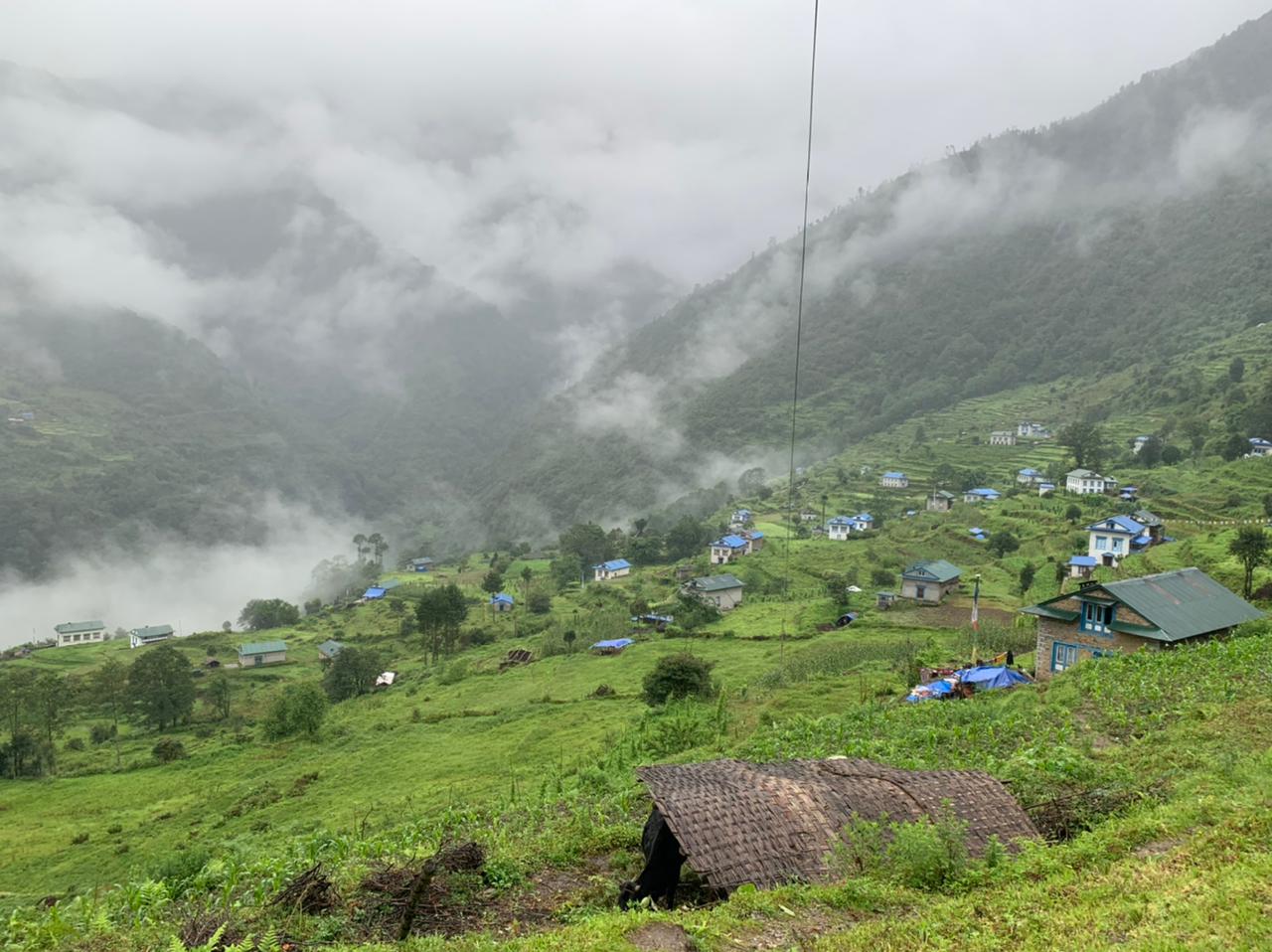 The village of Hewa, Solududhkunda Municipality 1, Solukhumbu, in monsoon (28 July 2022) 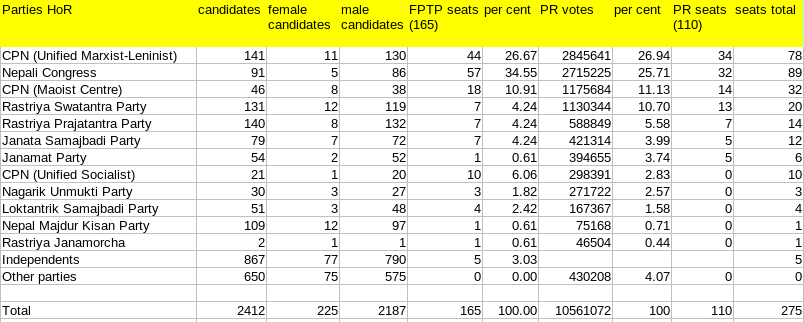
Final result of HoR elections 2022, based on
the Election Commission website
26/04/2024: Nepal fails to make progress towards delivering truth, justice and reparations to victims of Maoist conflict: Amnesty (nlt), Youth attempts suicide amid police torture over Facebook comments against home minister, by Tapendra Karki (rep) [The Maoist-led government is even committing new human rights violations through the police, who are fond of torture!], Aftab Alam, three others get life terms over 2008 killings : Rautahat Court convicts them of killing at least two people in Rajpur of the district on the eve of 2008 CA elections, by Shiva Puri (kp), District Court Rautahat sentences four individuals including Aftab Alam to life imprisonment, by Madan Thakur (rep), Pokhara Int’l Airport corruption scandal deepens : Former ministers under scrutiny as CIAA digs deeper (kh), Special Court orders judicial custody for Sunil Paudel over illegal wealth acquisition charges (rep), CIAA files corruption case against 10 persons, including Land Revenue Office staff in Solukhumbu (kh), Time to declare EVMs’ end : Don’t allow more public money to be drained by this project (rep), Stakeholders call for transparency as Beijing pushes for early implementation of BRI projects in Nepal (rep), Kathmandu takes lead as world’s most polluted city (kh), Air pollution takes its toll on Nepal’s tourism capital : As smog levels soar in Pokhara, travel trade entrepreneurs fear worse days ahead for the popular tourist destination, by Deepak Pariyar (kp), Government neglect leaves villages without piped water : Bad roads extend travel time between Ilam headquarters and Mangsebung Rural Municipality to over six hours although the distance is just 80 km, by Laxmi Gautam (kp), Ensure migrant workers’ voting rights: Lawmakers (ae) [The right to vote is one of the fundamental rights of all Nepalese citizens. The SC instructed the government to guarantee this right a long time ago. But this right is still denied to 25 per cent of the citizens!], Nepal’s investment climate myths (ae) 25/04/2024: The return of the chhau : Our campaigns to educate the people about the ills of ‘chhaupadi’ are inadequate (kp), Fire destroys 110 homes in Mahottari : Displaced families are sheltering at a local school. Relief immediate priority, officials say, by Sunita Baral (kp), Top court intervenes in Gaur massacre case : The Supreme Court orders the Rautahat District Police Office and the District Attorney’s Office to furnish written clarifications for not investigating the mass killing of 2007 (kp), New provincial cabinets slow to take full shape : From court cases to differences among ruling partners, chief ministers are struggling to appoint ministers (kp) [Nepal's so-called top politicians lack any understanding of federalism. They identify democracy with power struggles and are thus destroying the future of the country!], Evidence-Based Policy Making in Nepal: Challenges and the Way Forward, by Rakshya Silwal (rep), Election Key To Democratic Politics, by Mukti Rijal (rn), SC hearing on fake Bhutanese refugees case involving ex-deputy PM Rayamajhi today (rep), MoEST seeks EC’s help in identifying teachers linked to political parties (rep) [The right to be involved in political parties and to actively participate in political life is one of the fundamental rights of every human being in democratic constitutional states; this must therefore also apply to Nepalese teachers!], Former Minister Aftab Alam gets life imprisonment for Rajapur bomb incident (kh)
(30 March 2023) How inclusive is the Nepali state? Let's ask the 2021 census! Since
1990, the Nepali state has committed itself in its
constitutions to multiethnicity, multilingualism and
religious diversity in its society. This reality was
reaffirmed in the current constitution of 2015. At the
same time, another commitment was added, namely that of
ending the existing unequal participation of diverse
social groups in the state. In 2006, during Jana Andolan
II, this had been one of the most urgent concerns of the
people and had subsequently been declared a priority
goal by all political parties.
(19 February 2023) Let's celebrate National Oligarchy Day! In Nepal, they celebrate Democracy Day
for three days, whatever there is to celebrate. 72 years
ago, the then King Tribhuvan returned to Nepal from exile in
India and promised the people democracy, which is still
celebrated today. In reality, of course, it was all stink
and lies, as we all know. In the years that followed, the
monarchy did everything it could to regain and secure its
absolutist power, which ultimately ended in the almost
30-year-long party-less Panchayat system.
(25
December 2022) The dishonesty of Nepal's top
politicians
(27
November 2022) Attempt of a first election
analysis But it didn't this time. The voters
were, to put it bluntly, fed up and taught the top
politicians and their parties a lesson. The fact that this
did not turn out even more clearly is due to various
circumstances. For one thing, the insane electoral alliances
led to the competition between the parties in the
constituencies, which is typical of a democratic system,
being considerably restricted. Voters could no longer decide
freely. They had to be satisfied with the candidates that
the party leaders had chosen for them, basta! Or else they
had to resort to a protest vote.
(21 October 2022) The declared ideals of 2006 and today's political impasse The scorn of Nepali politicians knows no bounds. The top leaders of the ruling coalition, for example, repeat in monotone that their electoral alliance is necessary to preserve the constitution, stability and prosperity. Yet, the ruling coalition has failed miserably on all these three aspects in a similar manner as the Oli government before it. In reality, the leaders of all the major parties are only concerned with securing their re-election. If only one candidate from the camp of an electoral alliance stands in a constituency, his chances of re-election increase enormously. Only independent candidates can counteract this speculation, if voters realise in sufficient numbers that the same failed top candidates cannot be re-elected under any circumstances in the interest of the country, the people, democracy and the constitution. Another complicating factor is that this alliance system extremely reduces the number of potential alternative candidates of a party. Only the same old and long-since failed people are up for election. None of the so-called top politicians respects the constitution and laws. Indeed, they obviously do not even know them. Should they intentionally violate them, they would have to be brought to justice immediately. Their behaviour would be highly malicious and therefore not covered by any passage in the constitution and subordinate laws. The failed "top politicians" are a collection of male, predominantly high-caste politicians who want nothing to have to do with their own slogans of 2006, namely advocacy of social inclusion, democracy, federalism and secularism. For all of them, only their own very personal interests in power and all the privileges that go with it count. 16 years have passed since 2006. There can be no talk of social inclusion at all. It may have been in evidence at the time of the first Constituent Assembly election in 2008, but it was systematically dismantled thereafter. Even the inclusion provisions of the interim constitution were fundamentally disregarded. With the adoption of the new constitution in 2015, this was taken further in a decisive way. For example, the provision of the interim constitution to respect inclusion in the selection of direct candidates, which was never respected anyway, was removed altogether. Their proportion, mostly hand-selected males from predominantly so-called high Hindu castes, was increased at the same time. Only 110 of the 275 MPs are now elected by the people through the proportional representation system (PR). The latter is increasingly misused by top politicians in a nepotistic manner to infiltrate relatives, associates and friends into parliament. Since hardly any women are nominated as FPTP candidates, the prescribed 33 percent share of women in parliament must be ensured via the PR system. For example, putting the prime minister's wife on the PR list guarantees her safe election to parliament. In view of the fact that most of the FPTP candidates are men from the Tagadhari castes or Khas Arya (societal share of these men = 15 per cent), it seems downright grotesque that another 30 per cent Khas Arya are elected to parliament via the PR system. In this way, an adequate inclusion of "all" social groups, as pompously promised by the top politicians in 2006, will never be achieved. They don't even want this, and in 2006 they only talked about it like so many other things that they still pompously promise today but never really mean. Democracy means the rule of the people. The alliance politicians declare in all seriousness that they are standing up for this when they form an alliance. In reality, however, this is a paternalism of the voters. They are obviously to be declared too stupid to recognise which politicians are best suited to represent their interests and the needs of the state. Therefore, the alliance politicians take this agony of choice away from them. Voters are only supposed to cast their votes for the common candidate that the top politicians have previously negotiated in weeks of discussion, regardless of which party that candidate belongs to. That is not democracy, that is oligarchy and the dumbing down of voters. The idea of federalism was brought up in the 1990s by stakeholders of the Janajati groups and the then insurgent CPN (Maoist). Considering the fact that Nepal had hitherto been an extremely centralised state and that numerous regions and social groups were not really participated, this proposal seemed rational and later found its way into the basis for discussion in the Constituent Assembly. When the top politicians realised that the proposals put forward on the federal state threatened their privileges and state control, they increasingly took over the constitutional discussion themselves. Their disagreement on the issue of federalism ultimately led to the failure of the first Constituent Assembly. It was only with the change of majority in the second Constituent Assembly that the NC and CPN (UML) were able to push through their ideas of the federal state, which were more oriented towards the system of the Development Regions of the Panchayat period and denied any historical and ethnic reference even in the naming. Then, when the constitution was adopted, the inclusively elected representatives in the assembly were not allowed to introduce the concerns and ideas of the social groups they represented anyway. Article 3 of the 2015 Constitution
defines Nepal as a multi-ethnic, multi-religious,
multi-lingual and multi-cultural state. Such a state cannot
possibly be linked to the religion, language and culture of
a single one of these social groups. In this respect, it was
obvious to declare Nepal a secular state. A look at the
history of modern Nepal from the days of Prithvinaran Shah
to the last days of the monarchy makes it clear that the
close linkage with Hindu political ideas and ideals has been
one of the main causes of social inequalities,
discrimination and participatory exclusion. Despite the now
official commitment to secularism in the constitution
(Article 4), there are repeated calls for a revival of the
Hindu state. These come not only from those circles that are
party-ideologically committed to this albeit
unconstitutional idea, such as the RPP groups, but there are
also a number of politicians within the major parties who
occasionally flirt with this idea and closely link their
notion of Nepali nationalism to Hindu ideals. The best
example of the latter has been provided by former Prime
Minister Oli on different occasions. This may also be
related to the fact that most top politicians belong to a
cultural environment that is closely linked to Hindu values
and ways of thinking and lack necessary understanding of the
multi-ethnic society. If adequate social inclusion had taken
place since 2006, democracy, federalism and secularism would
certainly not be questioned today.
(24 October 2021) Worsening of
the national crisis The crisis of the Nepali state is progressing. After the coup-like dissolution of parliament twice and his removal by the Supreme Court, KP Oli with his CPN-UML continues to "successfully" prevent parliament from working. His successor as prime minister, Sher Bahadur Deuba (Nepali Congress, NC), is still not getting anything done after more than 100 days in office. A partly anti-democratic approach and cracks are also emerging in this government, the latter not least because of the possible signing of the MCC agreement with the USA, strongly advocated by Deuba. With his appointment of a brother-in-law of the Chief Justice (CJ) as minister, Deuba has also brought the Supreme Court under criticism. Assurances by the CJ that he strongly advised Deuba not to do so look implausible. The Bar Association is on the barricades, as are the CJ's colleagues in the Supreme Court. The judiciary has been permanently damaged. The NC party convention, which legally should have taken place by March 2021 at the latest, keeps being postponed. The upcoming party convention of the CPN-UML also seems to be experiencing problems. All four major parties are showing that they are not willing to learn. According to schedule, new elections are due in autumn 2022 at all three levels of the federal system. Moving them up significantly has long been called for by the CPN-UML and is now also being discussed by the ruling parties. But no matter when they are actually held, nothing is likely to change in the messy situation. The old and long-since failed leaders of all parties do not want to give up a millimetre of their power and control. In the NC, only veteran politicians, some of them 75-76 years old, are fighting for the leadership of the party for the next five years and, of course, for their candidacy for prime minister next year. Oli claims to have set in motion a huge rejuvenation process in the CPN-UML, but has enforced that the maximum age for election as party president and for candidacy for prime minister is 70. He himself will be 70 in February, so he is on the safe side. Meanwhile, the question of whether Oli has any legitimacy for state and party office after his attacks on parliamentary democracy, the constitution and the rule of law remains undiscussed. Pushpa Kamal Dahal's CPN-MC has forgotten all its once revolutionary claims. It has become a mainstream party whose leaders have long been concerned primarily with their own profit and power influence. The ideals they stood for in the ten-year militant uprising no longer count. Not only the Maoist fighters who put their lives and health at risk for these ideals feel betrayed, but also all those who had hope for the promised social and political changes and who in 2008 voted the Maoist party as by far the strongest political force in the first elections to a Constituent Assembly. Nothing is left and nothing will come. What remains of the major parties is the recently formed CPN-US (Unified Socialist) led by Madhav Kumar Nepal, which recently split from the CPN-UML. This party is still too young to really classify it. At best, one can see that even in this new party, the traditional patriarchal orientations have been preserved in the nominations to the various party bodies. At most, it will be interesting to see how many votes the two moderate communist parties, CPN-UML and CPN-US, will lose in the next elections. In 1998, the CPN-UML had already split over personal power claims. In the 1999 parliamentary elections, the two groups together received the most votes for the first time, but in the fight for seats in the then single-majority system they took the decisive votes from each other and helped the NC to an absolute majority of seats despite losing votes. The
question remains: What will the next elections bring for the
country and for the people? All indications are that the voters
will once again have no real choice. They will probably only be
allowed to decide which of the numerous failed high-caste male
top politicians they will vote for. Hopeful younger politicians
of both sexes and with a view to balanced social inclusion will
probably continue to be few and far between. The old heads in
all parties will ensure that. It already seems certain that no
party will win an absolute majority of seats. And Nepal has not
been able to cope with such a situation so far.
(10 October 2021) Will everything be better with PM Deuba? Exactly 90 days ago today, Sher Bahadur Deuba was sworn in as Prime Minister for the fifth time. The background is well known. KP Oli had tried to cover up his incompetence in an authoritarian manner. Several breaches of the constitution, repeated contempt of court and subversion of basic democratic norms ultimately left the Supreme Court with no choice but to remove Oli. Previously, Oli saw no reason to resign, neither in a clear vote of no confidence by the House of Representatives, nor in the explicit provisions of the Constitution, nor in the crumbling support within his own party. In a democratic state, these would be ample reasons to deny KP Oli the right to hold political office for all time to come. But Oli does not care about any of this. Internally, he has preferred to divide and possibly weaken in the long run his CPN-UML, which had developed into a formidable left force over the past decades - definitely not to Oli's credit. At the national level, even after his ouster, he has continued his efforts to destroy parliamentary democracy. Most notable here is the continuous blockade of both houses of parliament, sometimes enforced with considerable militancy. With hollow slogans, Oli and his closest confidants are trying to give the impression that an overwhelming electoral victory for the CPN-UML in the next elections is beyond all doubt. Actually, a clear age limit was supposed to initiate a rejuvenation process in the party. But in a recent amendment to the constitution, Oli ensured that the age limit with regard to running for political office was only set at 70. In February 2022, Oli will turn 70; before that, of course, he wants to be confirmed as party leader for another five years at the party convention in November and then also be his party's top candidate in the upcoming parliamentary elections in 2022. For about
a year, Oli as prime minister had blocked the legislative work
of the people's elected representatives because he could be less
and less sure of majority parliamentary support for his
increasingly abstruse policies. With the help of the president,
who was compliant with him in every respect, laws were no longer
passed by parliament, but were signed by Oli and then by the
president in the form of ordinances. So, Deuba has been Prime Minister for three months now. On 18 July, he was confirmed in office by a narrow two-thirds majority of MPs in a vote of confidence. What has changed since then? In short, remarkably little. It was clear that Deuba's power would depend on support from several opposition parties or party factions. In his vote of confidence, he had even received some votes from the Oli faction of the CPN-UML. At that time, the Supreme Court had explicitly ruled out negative consequences for voting in a way that deviated from the party line. But after that, the Political Party Act of 2017, in which top politicians had given priority to a party line constraint over a free vote of conscience by MPs on votes, was again in effect. In the worst case, the party leadership can revoke the status of MPs who disobey the party leadership's voting instructions. All that is needed is a simple notification to the secretariat of the House of Representatives. In order for a party's faction to split from the parent party without the MPs losing their parliamentary status, it had to get at least 40 per cent of the MPs behind it. This arrangement was critical for Madhav Kumar Nepal's UML faction MPs. They could not support Deuba, nor could they possibly agree to an amendment to the Political Party Act in parliament. However, without such an amendment, they could not separate. In this situation, Deuba resorted to the method previously practised by Oli and rightly criticised harshly. Deuba abruptly ended the session of the House of Representatives, changed the number of MPs required for a party split to 20 per cent by ordinance signed by the president, and reconvened the parliamentary chamber. Shortly after, the faction of MK Nepal split as CPN-US (Unified Socialist). As the opportunity was favourable, the faction around Mahanta Thakur also split from the Janata Samajbadi Party-Nepal (JSP-N), which also supported Deuba, under the name Loktantrik Samajbadi Party (LSP). Soon after, the Deuba government withdrew the ordinance amending the Political Party Act, so the law is again in force in the form it was before the party splits. Deuba had, after all, achieved what he wanted. With the parties supporting him, he could now hope for the necessary majority of MPs in votes. But this had nothing to do with democracy and constitutional procedure. Even after this "clarification" of the majority situation, however, it was to take weeks before Deuba could complete his rudimentary cabinet - four ministers had been sworn in together with him, and later Narayan Khadka was also added so that he could represent Nepal at the United Nations General Assembly. The reasons now lay in the dispute between the coalition partners over the respective number of ministerial posts and the division of the portfolio. It was only 88 days after he was sworn in that Deuba was able to complete this process. His cabinet now comprises 25 people, 22 ministers and three ministers of state. His NC has nine ministers and one state minister, while the CPN-MC, as the second strongest coalition party, has five ministers. The CPN-US and the JSP-N each have four ministers and one minister of state; after protests, the NC had given another ministerial post to the CPN-US. The fact that there are five women in the cabinet this time can be seen as a positive development to a limited extent. This corresponds to a share of 20 percent. This is the highest figure, at least since the Council of Ministers was limited to a maximum of 25 persons by the new constitution. However, Nepal has set itself a target of at least 33 per cent women at all levels of the state, so this is still a long way off. The high proportion of members of the Newar caste of the Shrestha is striking. They make up about one percent of the population. As Newars, they actually belong to the Janajati groups, but in the Hindu hierarchical thinking of the state elite on the basis of the Muluki Ain of 1854, they are classified as Tagadhari (bearers of the sacred string), to which above all the Bahun, Thakuri and Chhetri belong. Including the Shrestha, the Council of Ministers once again includes 16 Tagadhari (64 per cent, share in the total population around 30 per cent). In this respect, therefore, little has changed compared to previous governments. The Janajati are only reasonably represented according to their share of the population if the Shrestha are also assigned to them. The Madhesi are only involved through the JSP-N and are also slightly under-represented. Surprisingly, once again there is a Dalit as a minister (through the CPN-MC) Since about 12 per cent of the population is Dalit according to the 2011 Census, this continues to be an extremely blatant exclusion. Of course, it is difficult to put social participation in the Council of Ministers in relation to social shares. In view of the traditional imbalance, however, one can still speak of a continuation of the previous personnel policy. At most, it is still noticeable that the share of Bahuns in the Council of Ministers has declined significantly compared to the Oli government, although they continue to be overrepresented. Perhaps this is also related to the fact that the prime minister himself is a Chhetri this time. Given their population share, to have not more than two Bahuns in the Council of Ministers would be appropriate. The completion of the cabinet was overshadowed by another affair. Even before the final nomination and swearing-in of ministers, there were strong rumours that Chief Justice Cholendra Shamsher JB Rana was trying to gain influence over the composition of the executive. There were already strong protests from the media, civil society and lawyers about this mixing of the judiciary and the executive. Unfortunately, the ministerial list reinforced these initial fears. Gajendra Bahadur Hamal, a brother-in-law of the Chief Justice, was appointed Minister of Industry, Commerce and Supplies. He was not even a member of parliament and came from the district level of the Nepali Congress, so if in doubt, he would have had to become a member of parliament within six months if he wanted to retain his post. Another shadow fell on him because he had clearly advocated a return to the Hindu state in the past. But he is not alone in this in the NC; even general secretary Shashanka Koirala has repeatedly expressed this view. In view of the escalating turmoil, Hamal resigned from office on the second day after his swearing-in. There is
fierce criticism over the composition of the Council of
Ministers both within the NC and the JSP-N. Deuba, in any case,
has already amply demonstrated that he has not changed compared
to previous terms. Clearly, he is well on his way to his fifth
failure as prime minister. (5 July 2021) Constitutional crisis : Can it be solved? Corona infection numbers may temporarily decline. However, in view of the unchanged low tests, the lack of vaccines and the global developments, it is to be feared that a third wave will soon hit. The vaccination optimism spread by Prime Minister Oli seems misplaced. Meanwhile, the political situation is escalating. The Supreme Court has already rejected unconstitutional measures of the Oli government in various cases. Perhaps outstanding is the decision that the personnel change in the Council of Ministers was clearly defined as unconstitutional, thus reducing the Council of Ministers to five members. Oli could have easily read this in Article 77 (3) of the Constitution before making his decision. Presumably, however, he does not see himself as an interim prime minister at all. Yet Oli should not even be an interim prime minister after the elected MPs of the people in the House of Representatives withdrew their confidence in him. Due to the disunity of his political opponents, no alternative prime minister could initially stand for election. Therefore, President Bidya Devi Bhandari appointed Oli to continue in office as interim Prime Minister. As such, according to Article 76, he would have had to seek another vote of confidence in the House of Representatives within 30 days. Had he lost this one too, his time as prime minister would have been history. However, the situation changed within a few days with the nomination of a new candidate for prime minister through a list signed by 146 of 265 possible MPs. Realising that he no longer had a chance to maintain his power through legal means, Oli staged a coup with the active support of President Bhandari. Oli declared that he had even more MPs behind him than Sher Bahadur Deuba, the candidate of the opposition forces, of course without a list of signatures, because this was not possible at all in terms of numbers. Bidya
Devi Bhandari declared the situation as unclear, although she
only had to ask the House of Representatives for a vote. In
order to avoid any more opposition from the House, she, in
consultation with KP Oli, dissolved the parliamentary chamber
again, set new elections for November 2021 and reappointed Oli,
who already had lost the confidence of the people's
representatives, as interim prime minister until these
elections. Even more serious is the fact that the respective party leaders are given an almost absolute power. All major parties are characterised by factionalism. As a rule, the party chairman is the top politician who has the most members behind him at the two highest party levels. The party chairman is then largely free to decide on personnel appointments as well as on the party's political stances. Resistance comes at most from the other factions within the party if he does not take them sufficiently into account in personnel policy. In this sense, KP Oli sees himself as an almost absolutist ruler over his CPN-UML. His "world view" came into crisis when last year many MPs of his then still united party NCP opposed him and eventually even wanted to replace him as chairman and prime minister with another person from his party. This situation was aggravated when the Supreme Court annulled the merger of CPN-UML and CPN-MC. This meant that the CPN-UML was still the strongest party in parliament, but had lost its absolute majority. This majority was further reduced when the intra-party factions of MK Nepal and JN Khanal continued to oppose Oli and flirted with supporting a joint opposition prime ministerial candidate. Some of them then also signed the list submitted to the president. Since then, Oli has been clamouring that it is undemocratic for MPs of his party to disregard his directives as chairman and support the opposition candidate. This aspect will also play a role when the Supreme Court has to decide in the next few days on the renewed dissolution of parliament and the machinations of Oli and Bhandari. It is to
be hoped that the Supreme Court will decide in favour of
preserving democracy, the constitution and the rule of law. It
will not be able to avoid better defining the understanding of
democracy. It is also not acceptable for the Supreme Court to
make the opposition candidate prime minister as is demanded by
some lawyers on the plaintiff's side. This is not a task of the
court, but of parliament. This is a
personal analysis of the legal situation. The bottom line,
however, is that the question remains whether Nepal will find
its way back to political rationality without new elections.
Without a radical democratisation of the parties and the status
of MPs, a weeding out of the failed old political guard and a
much better social inclusion based on federalism and secularism,
however, new elections will not change much. (24
May 2021) Proposals for an
immediate rescue attempt of the people, the constitution and
democracy (8
March 2021) Has the Supreme
Court thought through its latest decision to the end?
The SC's decision to judge the May 2018 form of merger of
CPN-UML and CPN-MC into the NCP as illegitimate resolves some of
the conflicts that have been simmering for weeks between the two
factions of this ruling NCP, but at the same time it creates new
problems and contradictions. The SC has to face the accusation
that it has allowed the decision on the case filed by Rishi Ram
Kattel's NCP, which was already officially registered and
licensed under that name in 2018, to stew for more than two and
a half years. At the same time, the Election Commission must be
aware that it should never have registered the ruling NCP under
that name at that time, according to the existing law. (2 March 2021) State and democracy still in danger despite SB decision! On 23 February 2021, the Supreme Court finally delivered its long-awaited verdict on the constitutionality of Prime Minister Khadga Prasad Sharma Oli's dissolution of the House of Representatives on 20 December 2020 in cooperation with President Bidya Devi Bhandari. The Supreme Court's upholding of the unconstitutionality was a victory for democracy and confirmed for all time to come that Nepal's prime ministers have no right to dissolve parliament purely to satisfy their personal power needs. This breathed life back into the 2015 Constitution, which was thought to be dead after all. Oli's action can be considered a coup d'état. A constitutionally and democratically oriented prime minister would have drawn the only possible moral conclusion from this verdict and would have resigned. Oli obviously does not belong to this category of politicians. He clings to his office and declares that he will never resign. After all, he is the best and most successful government Nepal has ever had; only he knows where he sees evidence for this. As he did before the court verdict, he ridicules the breakaway faction of his inner-party rivals Pushpa Kamal Dahal and Madhav Kumar Nepal with the greatest possible scorn because they would never manage to win the majority of votes in parliament necessary for his ouster. At the same time, he surrounds himself with the aura of a potential martyr whose life is endangered by his rivals. Apart from the clear immorality of Oli's behaviour, the question arises how it is possible that a prime minister whose faction only has about a quarter of the members of the House of Representatives behind him is nevertheless not forced to resign by the remaining representatives of the people. The explanation lies in the equally lacking morality and democratic attitude of the opposition leaders. All top politicians are also primarily concerned with personal power, not with the people and the nation, be they called Dahal, Nepal, Deuba, Paudel or whatever. They are all unwilling to put aside their personal ambitions for power to get Nepal's democracy back on track. A second factor mentioned in this context is the unclear situation within the NCP. Both factions insult each other with accusations that go beyond any framework of politeness and exclude each other from the party. Yet an official split of the NCP has never been carried out. Both factions are demanding that the Election Commission recognise them as the legitimate NCP under that very name and with the electoral symbol of the sun. Although early parliamentary elections are off the table for the time being thanks to the court ruling, at some point the Election Commission will have to make a decision and the two factions will have to make a clear separation. However, they both clearly do not want the latter, as they are aware that the split is likely to make a parliamentary majority for the communists impossible in the long run, as was the case after the 2017 elections. Although the Nepali Congress (NC), as the main opposition party, has not been able to gain many points despite the Oli government's numerous advantageous proposals, the party is likely to win significantly more direct mandates again if the NCP splits. Oli's then CPN-UML was also just ahead of the NC in percentage vote share in 2017. Already within the NCP, the Oli group is the smaller faction today. Oli's failures on almost all fronts of governance, his authoritarian and in many cases human rights-suppressing policies, and most recently the utterly senseless waste of taxpayers' money through the unconstitutional dissolution of parliament and the forced preparation of early new elections are likely to cost the Oli faction further votes. In any case, if the NCP were to split, the votes in favour of that party in new elections would be split between two parties. This too would probably play into the hands of the NC. These considerations have now also reached the top politicians of the Dahal Nepal faction. Since it has become clear that neither of the two opposition parties, the NC and the Rastriya Samajbadi Party Nepal (RSPN), is prepared to support a vote of no confidence against Oli in the reinstated parliament as long as the NCP's internal party relations have not been clarified, there have been tentative considerations to restore the NCP's unity after all. But that would mean accepting all of Oli's misconduct and continuing to accept him as prime minister and party leader. That would indeed be a change of mind that would be difficult to convince rationally and democratically minded people in Nepal of. The very misery of Nepali democracy, which is particularly evident in the current crisis, has a lot to do with the lack of democratic structures in the parties. All parties are extremely centrist and oriented towards a few leaders, who in turn usually form factions within the party over time. Whoever makes it to the top level of the party is almost impossible to get out of it, no matter what he is guilty of and how miserably he fails in the fulfilment of his tasks; all prime ministers of the last few years can be cited as examples here. This is also due to the fact that the lower party levels have hardly any influence on the top party levels. The top politicians decide to a large extent on the composition of the two highest party bodies and are careful to ensure that the proportion of their clientele is maintained there. Even in the nomination of candidates for parliamentary and provincial elections, the decision-making power lies largely with the central party leadership. This is the same for all parties. It also contributes to the fact that at least the upper levels of the party are far from reflecting the composition of society: In extremely patriarchal Nepal, men dominate quite predominantly, especially those from the Bahun and Chhetri circles. Given the aforementioned party structures, it is not to be expected that this will change quickly. Another significant aspect is the inability to realise justice in relation to past crimes or misconduct, or strictly speaking, the denial of such justice. Here, too, all parties are involved. If one takes the massive international call for justice for the victims of the Maoist insurgency alone, it is clear that many of today's top politicians had to bear responsibility at that time, whether as direct participants such as the former Maoist leaders or as state politicians who were responsible for the deployment and conduct of the security forces. Only two examples should be mentioned here. Pushpa Kamal Dahal declared some time ago that he was responsible for the deaths of around 5,000 people as the then head of the Maoists. But that does not stop him from continuing to aspire to leading state and party offices. It does not even occur to him to take responsibility before a court. A second example is Sher Bahadur Deuba, the chairman of the NC and four-time prime minister. He paved the way for the Maoist insurgency when, as prime minister in 1995, he militantly yet unsuccessfully tried to suppress the initial organisation of the Maoist party in mid-western Nepal. In early 1996, he refused to even discuss the 40 demands of the Maoists, although most of them were completely rational and many dealt with the state policy guidelines of the then constitution, which the government paid little attention to. In 2001, Deuba then pushed through the mobilisation of the army against the Maoists, which led to a complete escalation of the conflict. The fact that in 2002 he also called on King Gyanendra to dissolve parliament, thus dealing a death blow to the political system of 1990, is also worth mentioning in view of Oli's current misconduct. Against
this background, it is legitimate to ask whether the current
party political leaderships are not mainly responsible for the
permanent crisis and the constant setbacks of Nepal's democracy.
If one answers this question with a yes, one should discuss how
Nepal can move towards a better democratic path. However, it
should not be enough to replace the old failed leaders with a
new generation. This generational change must be accompanied by
a complete renewal of the political parties, whereby in the
multi-ethnic state of Nepal, adequate social inclusion is
finally needed. (23
February 2021) Democracy is
still alive in Nepal! For a good two months,
Prime Minister Oli could pretend that he was an absolute ruler,
that he was above the Constitution and any legislation. Like
Oli, his closest henchmen and his defenders proclaimed in the
Supreme Court that the prime minister had every right on his
side. Early elections in April and May would be completely out
of the question. (3 February 2021) Even 45 days after the dissolution of parliament by Prime Minister KP Oli and President Bidya Devi Bhandari, the proceedings on the constitutionality of this action continue in the Supreme Court. Meanwhile, the submissions of the lawyers of the plaintiff sides have been completed. Since Monday, the lawyers of the government side have had the floor. It is striking that the latter, in contrast to the lawyers of the plaintiff side, hardly refer to the constitution in their justification of Oli's and Bhandari's action. This is probably due to the fact that the Constitution does not really provide a justification. Thus, the defenders of the Oli government declare that such action is perfectly normal for a parliamentary democracy. Or they claim that Oli's action was necessary to preserve Nepal's sovereignty and nationalism. One has to think several times about what lies behind these arguments. According to the constitution, Nepal's sovereignty lies with the people. The representatives legitimately and democratically elected by the people are the members of the House of Representatives. They therefore represent the sovereign people in Nepal's parliamentary system. Dependent on this House of Representatives is the executive power. The representatives of the people elect a Prime Minister, who then forms a Council of Ministers to carry out and coordinate the official business of the country. To be elected, the prime minister needs the approval of a majority of the MPs within the House of Representatives. If a party has a clear majority in the House of Representatives, that party's top candidate is usually confirmed as prime minister, as provided by Article 76 (1) of the Constitution. If no party has an absolute majority, the candidate additionally needs the votes of one or more other parties, according to Article 76 (2). When KP
Oli was elected Prime Minister in February 2018, his CPN-UML did
not have an absolute majority in the House of Representatives.
Oli was therefore elected under Article 76 (2) as he was also
still elected by CPN-MC MPs who had already formed an alliance
with CPN-UML in the elections. Therefore, as required under
Article 76 (4), Oli faced a vote of confidence in the House of
Representatives within 30 days, in which he received almost 75
per cent of the votes. This whopping majority was further
consolidated two months later when the two parties merged to
form the NCP. In such a case, it is the task of a prime minister to prove that he or she still has the confidence of the representatives of the sovereign people. In accordance with the basic principles of a democracy, this is done by the prime minister asking the House of Representatives for a vote of confidence. If he wins this, he automatically remains in office and his opponents have failed. If he loses the vote, he is automatically voted out and another candidate must seek the majority of MPs. In addition, his political opponents can also bring a vote of no confidence in parliament on their part. If a prime minister sees no chance of winning the vote of confidence in parliament from the outset, he can of course resign right away. These would have been the only options for the hard-pressed Prime Minister Oli in December 2020 at the latest. In fact, he should have faced these democratic options much earlier in order to avert greater damage to Nepal's state and society, especially in times of pandemic. But Oli seems to understand and interpret the constitution and democracy differently. He probably sees parliament as representing the sovereign people only until they have elected the prime minister. After that, sovereignty passes to the latter. This is evidenced by Oli's dealings with parliament over the past three years. When parliament was active, important laws were often simply not passed. Time and again, Oli bypassed parliament by issuing ordinances in close cooperation with the president when parliament was not in session. This was easier for him, because then he was not bound by any votes and could push through what he liked. The amendment to the Constitutional Council's decision-making procedure on 20 December was tantamount to a constitutional amendment by ordinance. The dissolution of the House of Representatives just five days later was a stab in the back for Nepal's fledgling democracy. It turned the constitution's provisions on sovereignty upside down. The Prime Minister, dependent on Parliament and accountable to it in every respect, dissolved the elected body of representatives of the sovereign people to preserve his personal power and impose policies that marginalised his political opponents. The argument of Oli's lawyers now before the Supreme Court that he had no other choice to preserve sovereignty, which is actually that of the people, is probably understood only by himself and his most adamant supporters. And the argument of preserving nationalism bodes ill. For months, Oli has presented himself as a Hindu fundamentalist. That would be the last thing Nepal needs now. Oli and
Bhandari undoubtedly bear the main responsibility for the
escalation of the political and constitutional situation. But
one should not absolve Oli's inner-party opponents, as well as
the top politicians of opposition parties, from a more or less
large share of the blame. In particular, in the context of the
disputes on the streets and in the media, no real separation is
discernible on all sides between the question of the legitimacy
of Oli's steps and their own respective ambitions for power. (10 January 2021) The unresolved legal situation continues unchanged, while PM Khaga Prasad Sharma Oli continues to intensify his campaign for the new elections he has called for the House of Representatives. He accuses the four former chief justices, who had clearly declared themselves on the unconstitutionality of the dissolution of parliament, of interfering in an ongoing court case and attempting to influence the Supreme Court. Meanwhile, he himself continues to claim every right to call his action constitutional; that the House of Representatives will not be reinstated under any circumstances and that the elections will be held as announced. But such words from the mouth of the Prime Minister, of course, have nothing to do with influencing the decision of the judiciary. At the same time, Oli is trying to keep the state apparatus under his unrestricted control. Thus, in order to preserve the appearance of democracy, the winter session of the remaining parliamentary chamber, the National Assembly, was convened on 2 January, but on 10 January Oli had the session ended again after only four meetings. The fact that he spat on the floor of the National Assembly on this occasion makes it clear what he thinks of this democratic institution. Also, why does Oli need a legislature at all when Nepal has such an able and powerful PM? This way, Oli can pass laws, as he wants them, by ordinance and have them signed by his president. He has repeatedly used this as an ideal way in the past almost three years of his tenure. Meanwhile, demonstrations against Oli's unconstitutional actions (here called so with no hidden agenda of influencing the court out of full conviction) are taking place in all corners of the country. Meanwhile, Oli also likes to have such demonstrators arrested by the police. At his own election rallies, the wearing of black masks is strictly forbidden, as this could be a symbol of protest. Even black breathing masks have to be removed. What does Oli care about protective measures against the spread of the pandemic? Any other kind of demonstration is also prevented at such events. In Dhangadhi, for example, a group of young people were arrested because they wore appropriate shirt inscriptions to remind people of the continuing lack of investigation into the rape and murder of Nirmala Pant and demanded justice. Since the crime, there have been accusations that the highest political circles are deliberately preventing the investigation. Finally, the camp of the advocates of a return to monarchy and the Hindu state must unfortunately also be addressed. The anniversary of Prithvinarayan Shah's birth is a welcome occasion to remember the founder and military unifier of modern Nepal. While it is true that Nepal owes it to this Shah king that it still exists today as an independent state and has not been absorbed into the Indian Union, it must also be remembered that the policies of Prithvinarayan Shah and his successors are responsible for the system of patriarchy, inequality, exclusion and discrimination that makes it so difficult today to transform Nepal into a modern democratic state. Significantly,
ex-king Gyanendra once again spoke out today, pretending that
his main concern was the preservation of the country. What is
meant by this was made clear by Kamal Thapa, the chairman of the
RPP, when he once again called for a return to monarchy and the
Hindu state. Criticism of today's supposedly democratic
politicians is made easy for the monarchists these days. Oli and
the other so-called top politicians are well on their way to
destroying the country. But they are only completing what the
monarchy could not complete before. Only a younger charismatic
generation of politicians from among Nepali citizens with a
commitment to inclusion, democracy and secularism and an
aversion to theocracy and overrated political ideologies can
save the country! (8
January 2021) How similar
things are: When the US president incites his
most diehard supporters to initiate a coup from above against
the state and democracy for the purpose of retaining power,
statesmen all over the world condemn his action. Not so PM
Khadga Prasad Sharma Oli and his government in Nepal. Why should
they, Oli has behaved similarly to Trump after he could no
longer hold on to power through democratic means. Trump has the
American parliament stormed, which was about to confirm his
ouster, Oli dissolves the Nepalese parliament so that the
democratically elected representatives of the sovereign people
there cannot deprive him of executive power.The latter, by the
way, is a legitimate democratic right of parliament. Yet Trump
in the US and Oli in Nepal have, in four respectively three
years of failed politics, provided ample grounds for voting out
or removing from executive power. The
Dahal-Nepal faction of the NCP continues to pretend that its
primary concern is the withdrawal of the dissolution of
parliament. In keeping with the media, its leaders position
themselves in a strictly hierarchical order at the forefront of
the sit-ins on the streets. However, since it became clear that
the other parties are not willing to join them in protest
actions, the focus for Dahal and Nepal has also shifted more
towards new elections. The visible sign at the moment is the
effort to be recognised by the Election Commission as the
legitimate NCP with a view to the future. Of the
other parties, the RPP should be mentioned here, although this
party seems completely insignificant in view of the election
results of 2017. The problem is that this party of die-hards is
trying to use the chaos caused by Oli and the NCP to promote a
return to monarchy and the Hindu state through mass
demonstrations. Their leaders are proving that they have
clearly not understood the history and society of Nepal. The
demand for such a step backwards is unlikely to be successful,
but it further exacerbates the current chaos. (Tsak Sherpa)
(6 January 2021) The political crisis continues. Today, the Supreme Court began hearing the 13 constitutional petitions that followed the dissolution of parliament by Prime Minister KP Sharma Oli and President Bidya Devi Bhandari. Of the 5 judges of the Constitutional Bench, Hari Krishna Karki has retired. He had been accused of bias as he had served as Attorney General during the first Oli government. The trial is scheduled to resume on 13 January 2021. Meanwhile, both infighting between the two factions of the NCP at all levels of the federal system and protests by other parties continue unabated. Both NCP groups are showering accusations on each other and trying to damage the other group and push it out of power. For a long time now, this dispute has been endangering the very foundations of the entire state, especially since the leaders of the two factions seem to be mainly interested in their personal ambitions for power. PM Oli is continually escalating into a defence of the legality of his actions. In the meantime, he is even claiming that this was a purely political measure on which the Supreme Court is not even entitled to judge. One can only hope that the Supreme Court will reach a verdict on the constitutionality of the dissolution of parliament as soon as possible. In a democratic state, a prime minister has only two options if his government loses its majority: resignation or at least a vote of confidence in parliament. The elected representatives of the sovereign people sit in parliament. Oli owes his office only to the election by this Parliament, which alone has the right to deprive the PM of legitimacy. The dissolution of the House of Representatives, avowedly for Oli's personal retention of power, is therefore tantamount to a coup d'état. But even if the Supreme Court reverses the dissolution of parliament, there remain legitimate doubts that this parliament will last much longer. The top politicians of the two factions have already destroyed Nepal's democratic system too much. There will be no stable governing majorities either at the central level or in the provinces after a possible restoration of parliament. In any case, the question of legitimacy remains. At the top of all the major parties are ageing leaders, some of whom have already failed several times or whose legitimacy to exercise power is at least questionable because of their political past. As a logical consequence, even if the House of Representatives is reinstated, there will probably be early elections sooner or later. However, with the current, largely over-aged party leaders, even these could be forgotten. Given the large parliamentary majority, the Oli government would have had a unique opportunity to stabilise Nepal politically and advance the country's development. Oli has miserably squandered this opportunity. Meanwhile, the Corona pandemic continues to affect all aspects of life. But that does not seem to interest the politicians of all parties at all. The daily announced case numbers may seem low compared to western industrialised countries, but the value of the numbers mentioned is doubtful in view of the extremely low number of daily tests. While in most countries of the world the numbers of infections and deaths are steadily increasing or at least have remained at a high level for weeks, the numbers in Nepal continue to fall unabated. And this despite the fact that the Oli government continues to do absolutely nothing to control the spread of the pandemic. Economically, too, there is hardly anything that can be glossed over. So the comments on the revival of the all-important tourism sector seem like a nice dream. Reports on the death of hotels speak a clearer language. In view of the current world situation, Nepal should rather assume that 2021 will remain another lost year for international tourism. (Tsak Sherpa)
|
Related
Websites: The
following trekking agencies are run by persons from Hewa (Solududhkunda
Municipality 1) who invest a lot of time and money in the
development of their village. By bringing tourists to
Hewa, they contribute to improve the income of the
villagers and to sustain the projects: Verein Nepal-Inzlingen - Hilfe für
Kinder in Nepal e.V., Inzlingen, Germany |
||||||||||||||||||||||||||||
| Copyright © Nepal Research. nepalresearch.org is not liable for any unsuitable material found in any of the links included in this web site. Please contact the respective web sites for any relevant information. |
|